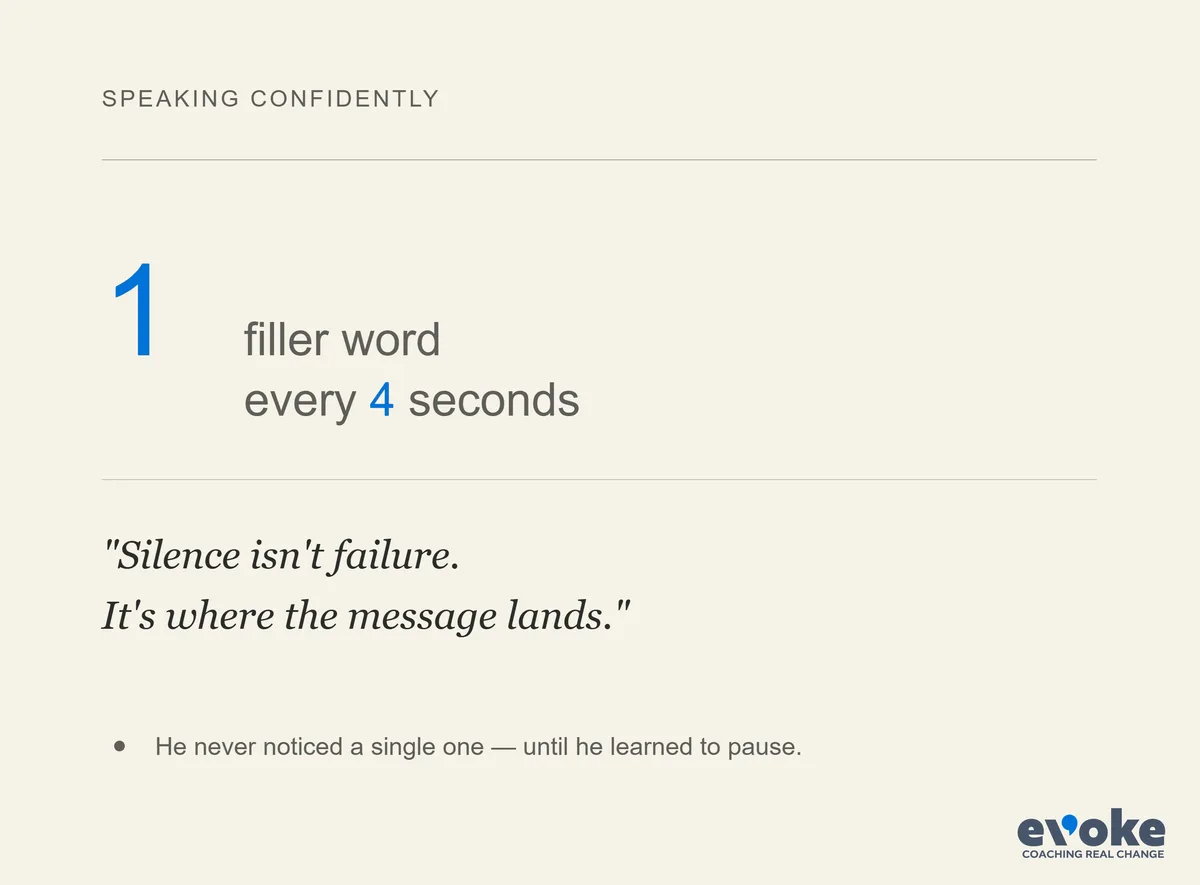
We counted 124 filler words in his eight-minute talk.
That's one every four seconds.
He hadn't noticed a single one.
The filler words weren't the problem.
They were what happened when silence felt unsafe.
I coach talented technical professionals.
Sharp minds.
Strong opinions.
Real technical depth.
And many of them share the same blind spot.
They spend most of their energy thinking about what to say.
Often, the bigger opportunity is how they say it.
This guy — really smart, genuinely likeable — communicated the way many technical professionals think: fast, dense, no white space. Ideas stacked on ideas. Every gap filled with "um," "so," "like," because to him, silence felt like failure. Like he was losing the room.
So we started small.
Before we touched tone or structure or anything clever, we focused on one thing...
Giving himself permission to pause.
Just… stopping.
For two seconds.
Then three.
Long enough for an idea to land before the next one arrived.
From there, it built:
- Slowing his tempo so his best points didn't get buried in the rush.
- Frameworks to create thinking time under pressure, instead of scrambling for words.
- Tools to stay steady when a question turned hostile.
- Eventually, learning to run a room full of competing voices instead of just surviving it.
Somewhere in that process, something shifted that had nothing to do with technique.
He described it as "it's freeing — like less of a noose around your neck."
Not faking calm — actually feeling it.
That's the part that gets me every time.
The communication skills are just the vehicle.
What people are really after is the freedom underneath.
If you've ever left a meeting thinking, "I knew exactly what I wanted to say—but somehow it didn't come out that way," you're not alone.
That's the work I love.
He didn't become a different communicator.
He became the communicator he'd always been underneath the anxiety.
Nothing about his expertise changed.
What changed was that people could finally see it.
That's what good coaching can unlock.