He'd just updated 5,000 records in the wrong environment.
UAT, not production. (Small mercy.)
But still the kind of moment where your stomach drops before your brain catches up.
A few months earlier, this would have sent him straight into panic.
Not because he didn't know what happened — he did.
The panic was never really about the facts.
It was about not knowing how to get them out of his head and into the right order, fast, while someone senior was waiting for an answer.
This time was different.
He paused.
Took a breath.
Walked the lead engineer and DBA through what happened — calmly, and in sequence.
Afterwards, he told me: "Usually I would panic and be stressed out. In this case I didn't, because I wasn't bothered what they were thinking. I saw some improvement there."
He's a senior software engineer.
Sharp. Technically excellent. The kind of person whose messages are more considered than most people's essays.
But in the moment — live, unscripted, someone waiting on him — the ideas that were completely clear in his head kept arriving in the wrong order, or not arriving at all.
The problem was never that he couldn't think.
It was that fear was scrambling the order of his thoughts.
We didn't spend time on standard communication skills.
Just three things:
- A deliberate pause
- A simple frame before the detail
- Stop treating "not perfect" as "not good enough."
Near the end of our work together, he described the shift like this:
Version 1:
"I panicked. I didn't know what to say — I might look stupid."
Version 2:
"I say whatever I have to say. I don't know whether they understand it, I don't care, I just say it."
Version 3:
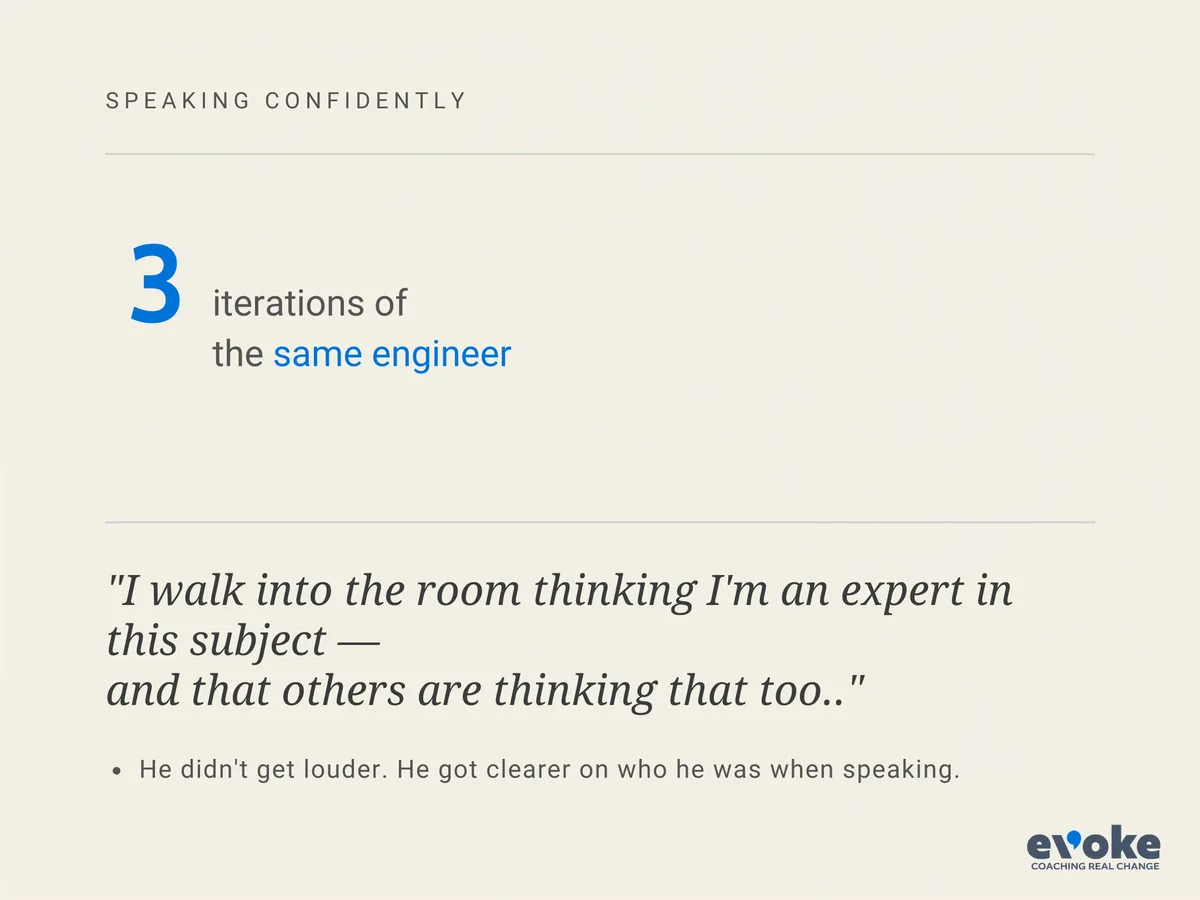
"I walk into the room thinking I'm an expert in this subject — and that others are thinking that, too."
I don't think that progression is unique to engineers, or to anyone speaking a second language.
I think a lot of technically excellent people are quietly stuck at Version 1 — waiting until an idea is perfect before they're willing to say it out loud.
It rarely needs to be perfect.
It just needs to be clear enough for the conversation to move forward.
Confidence isn't having the perfect answer.
It's trusting yourself to think out loud.